Back
The 1940's

The 1940's

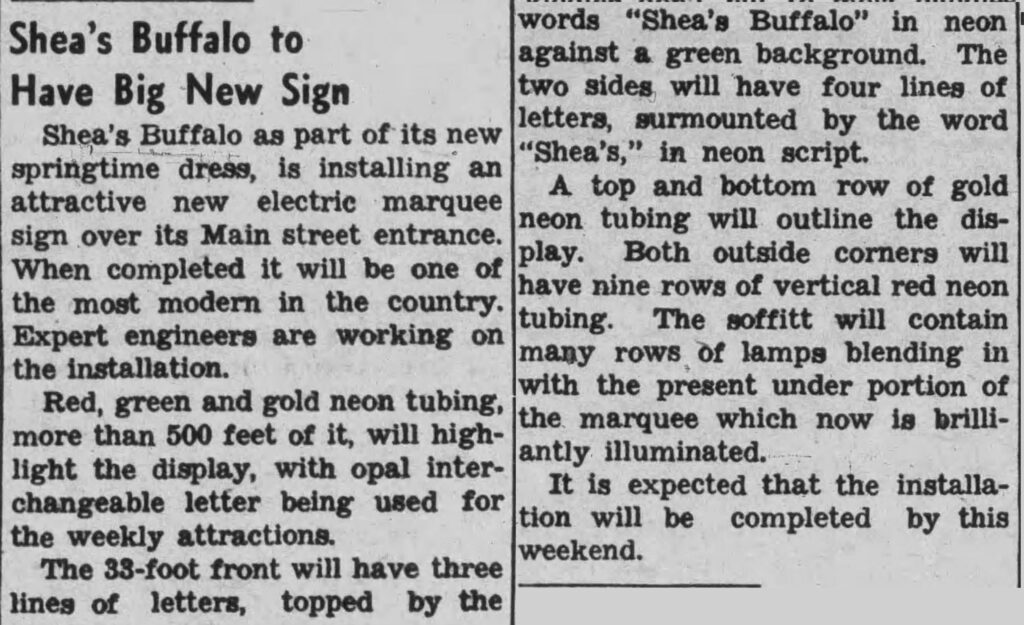
In 1942, the original marquee was replaced by a new electric sign and would stay up for the next fifty-two years.

Photo Credit: Catholic Union and Echo - March 27, 1942

In 1942, the original marquee was replaced by a new electric sign and would stay up for the next fifty-two years.

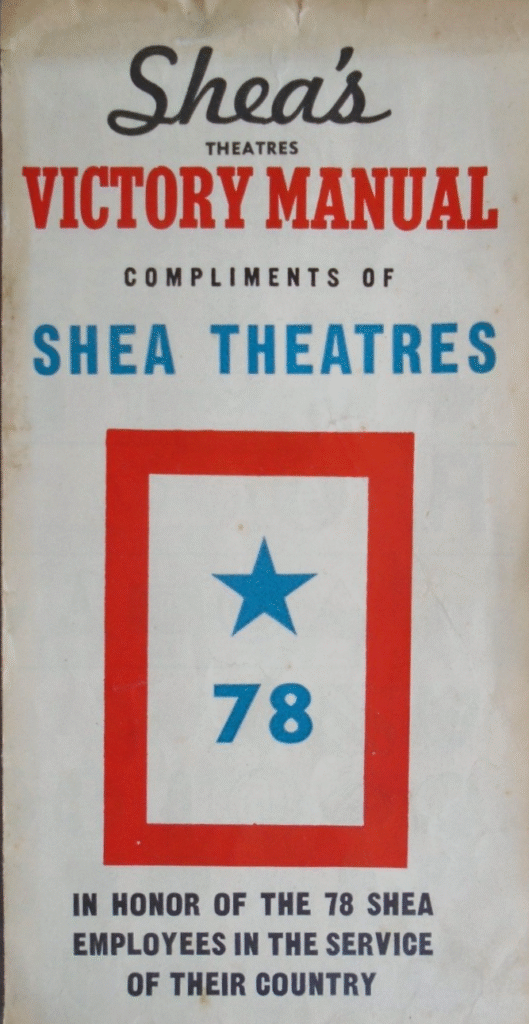
These pamphlets were handed out during shows in support of Shea's employees who were serving in World War II while those here on the home front worked to raise money and morale. With men drafted to serve, the live orchestra was retired in 1940 and the theater switched to coal heating (which left layers of grime that wouldn't be fully removed until 2014 with the ceiling restoration work). Recruiting booths were set up in the Grand Lobby and newspaper ads for young boys to work after school as ushers. On the screen, news reels and political cartoons were incorporated into movie showings - even the movies themselves were subjected to propaganda served by the United States Office of War Information.

These pamphlets were handed out during shows in support of Shea's employees who were serving in World War II while those here on the home front worked to raise money and morale. With men drafted to serve, the live orchestra was retired in 1940 and the theater switched to coal heating (which left layers of grime that wouldn't be fully removed until 2014 with the ceiling restoration work). Recruiting booths were set up in the Grand Lobby and newspaper ads for young boys to work after school as ushers. On the screen, news reels and political cartoons were incorporated into movie showings - even the movies themselves were subjected to propaganda served by the United States Office of War Information.

The Andrews Sisters

March 6, 1942
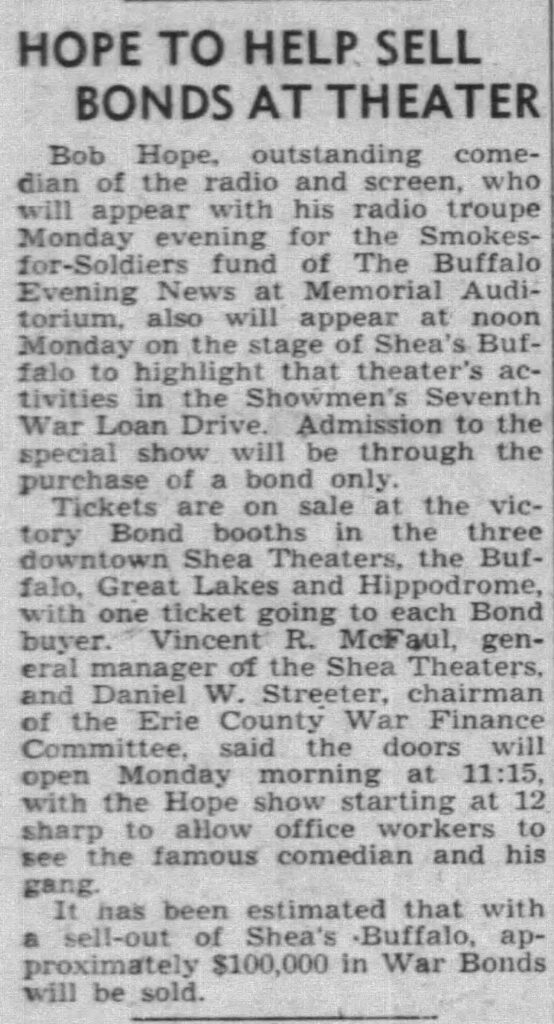
Shea's theaters stayed open during World War II, to provide the much-needed entertainment for the home front but also serving as a source of fundraising for the war efforts. Stars like Bob Hope appeared across the country, hosting drives to sell war bonds and support the Red Cross.

Photo Credit: The Buffalo News - May 21, 1945

Shea's theaters stayed open during World War II, to provide the much-needed entertainment for the home front but also serving as a source of fundraising for the war efforts. Stars like Bob Hope appeared across the country, hosting drives to sell war bonds and support the Red Cross.

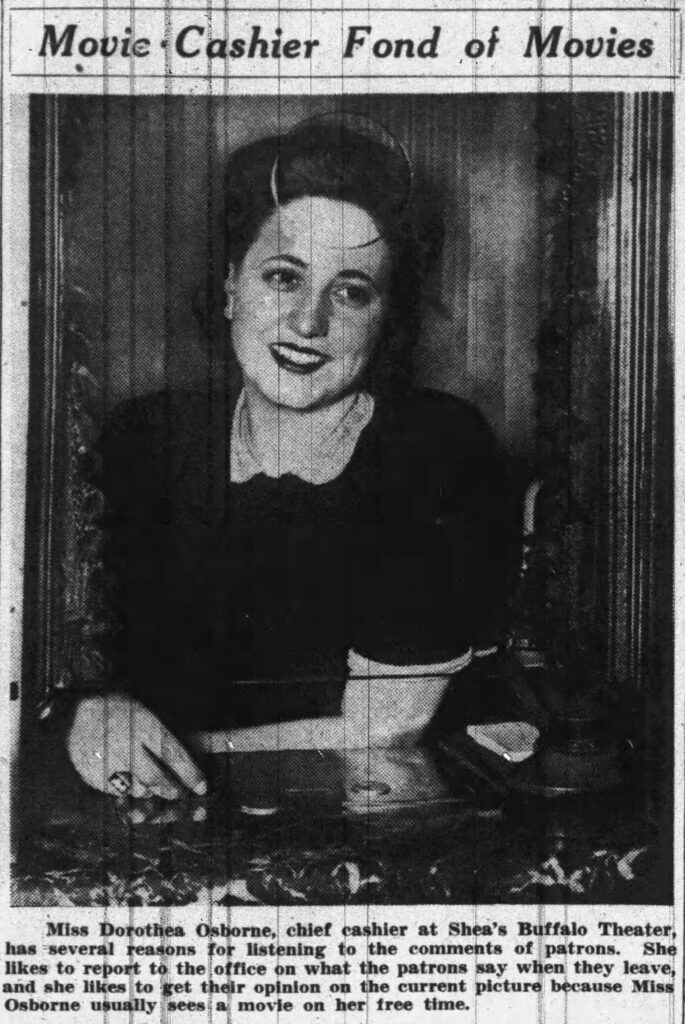
Miss Dorothea Osbourne, chief cashier, was interviewed by the Buffalo Courier-Express about her work here at Shea's Buffalo Theatre. "I always report on reactions to the office. When patrons come out smiling and happy, we know we have a hit."

Photo Credit: The Buffalo Courier-Express - January 5, 1941

Miss Dorothea Osbourne, chief cashier, was interviewed by the Buffalo Courier-Express about her work here at Shea's Buffalo Theatre. "I always report on reactions to the office. When patrons come out smiling and happy, we know we have a hit."

The Ink Spots, Cootie Williams, and Ella Fitzgerald

June 22, 1945

Frank Sinatra, as the baritone soloist of Tommy Dorsey's Stage Revue

September 20-25, 1941

Theater Organists

Some of the most famous theater organists of the day played the Shea's organ at one time or another including Lloyd Del Castillo who dedicated the instrument when the theater first opened in January of 1926; Harold Ramsay, a well-known Canadian organist; Henry Murtagh who played it for several years; the renowned Jesse Crawford who played it for two weeks during the theater's eleventh anniversary celebration in January 1937 and a host of others. With the outbreak of World War II the organ ceased to be used on a regular basis, the last musician to have played it being Arthur Crosson, a well-known local organist. The last time the organ was played professionally during this time was in July of 1964 when the American Theater Organ Enthusiasts held their annual convention in Buffalo, played by Pearl White, Gaylord Carter, and Lowell Ayars during their convention.

Red Skelton with Harry James and His Orchestra

January 1, 1940

Abbott and Costello

November 1, 1940
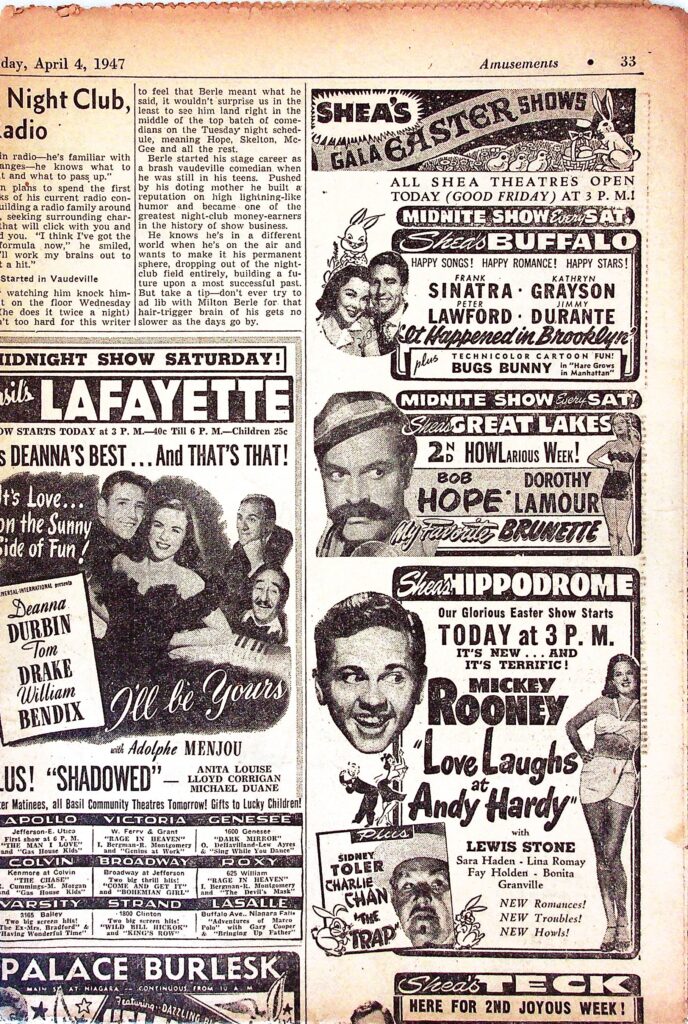
Advertisements for various Shea's theatres playing Easter Weekend

Photo Credit: Buffalo Evening News - April 4, 1947

Advertisements for various Shea's theatres playing Easter Weekend

United States vs. Paramount Pictures

When Shea's Buffalo Theatre first opened, Hollywood film studios sold their films to movie houses under a practice called "block booking", where a movie theater was obligated to buy all of the studio's films to show - until 1948, when the Supreme Court ruled in United States vs. Paramount Pictures, a landmark antitrust case that lead to the decline of the Hollywood studio system and forced the ownership of Shea's Buffalo to be eventually sold to Loew's theatre chain. This decision would go on to be known as the "Paramount Decree" until it was finally lifted on August 7, 2020.

The Ink Spots

February 12, 1949
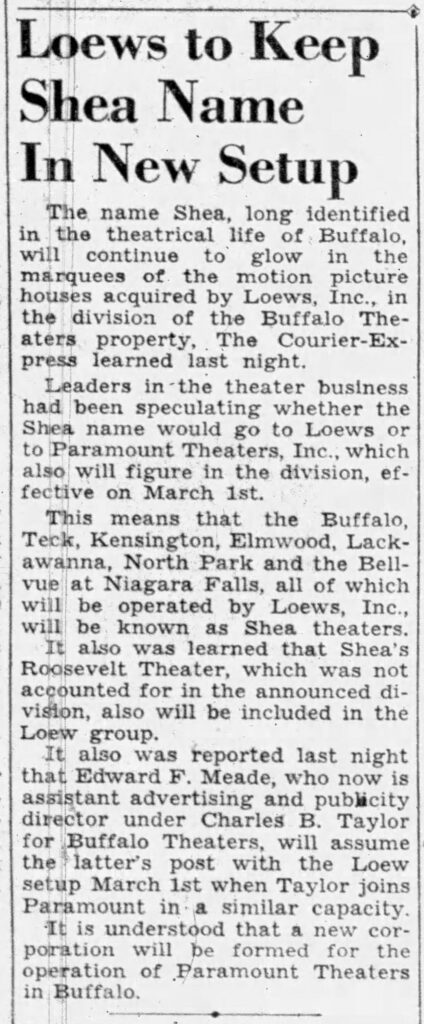
Following the fallout of United States vs. Paramount Pictures, the Shea's theater chain was divided and sold off, with Shea's Buffalo Theatre acquired by Leon Lawrence Siddell of Loews Inc.

Photo Credit: The Buffalo Courier-Express - February 20, 1949

Following the fallout of United States vs. Paramount Pictures, the Shea's theater chain was divided and sold off, with Shea's Buffalo Theatre acquired by Leon Lawrence Siddell of Loews Inc.