Not-so-Silent Movies
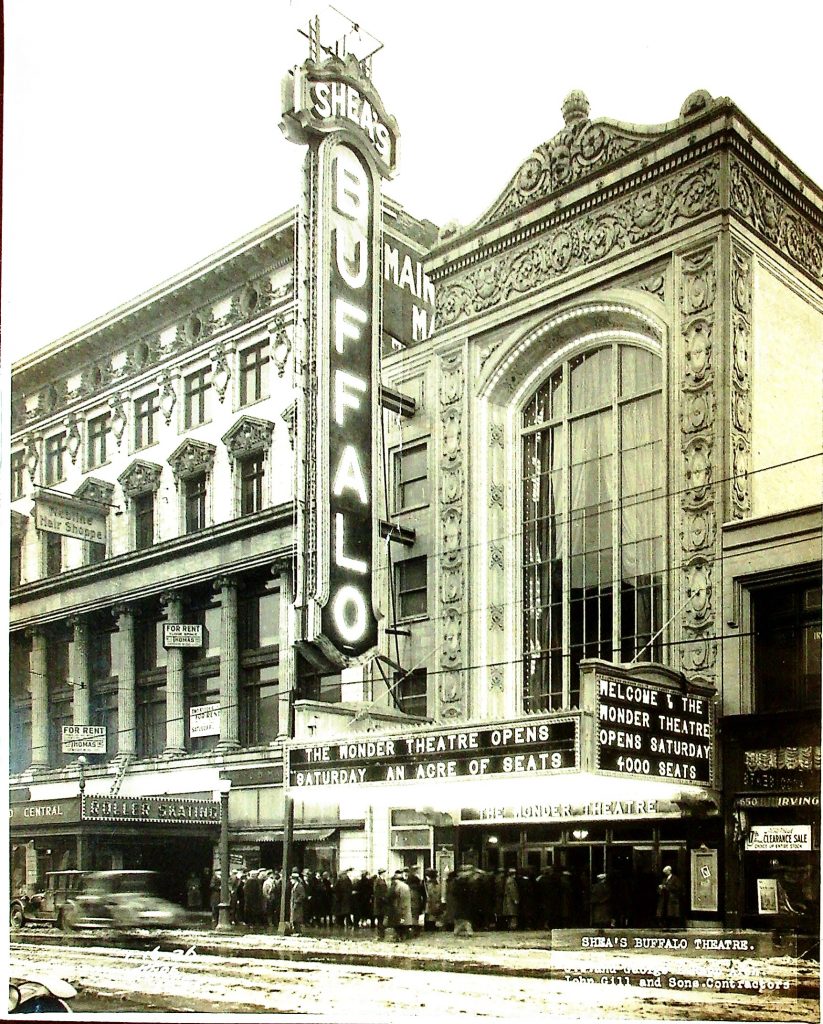
The first 'talkies' wouldn't come to Shea's Buffalo until 1928 - but silent films were hardly quiet. They were accompanied by music to play along with the picture, and at Shea's Buffalo, it was performed by a full orchestra and the Mighty Wurlitzer. "If I could take the entire audience in a little tour behind the scenes they would marvel at the amount of time, money and painstaking effort we take to score a picture." Conductor Harry Wallace was quoted, describing the full week-long process of bringing a movie to life with music:
There is the screen room, where the orchestra leader first views the feature picture. He sits in front of a speedometer which gauges the speed at which the film is being run through and jots down every title, subdivision and descriptive action having a bearing on the story, together with a notation as to the proper type of music accompanying the action.
The cue sheets are taken to a master library where proper types of music are selected through a cross index of 500 classifications. After the conductor part has been complied, the director again reviews the picture with the score and cue sheets before him. This time, it is necessary to read the music, the cue sheet, write in the music abbreviated cues, and watch the films to make proper stops for each separate piece of music. The score is then edited so that each number will finish pleasantly to the ear, so the blend from one number to the next is never jarring on the hearers.
It is necessary then for the librarian and his associates to arrange the corresponding music for each musician, properly marked from the conductor's copy, so that at performance the orchestra plays only the portions marked for them. When completed this score, it many respects hand-written, is a veritable grand opera. So closely does it follow the action that were it played without a picture it would be apparent that an entire story was being unfolded.
 Back
Back